Trust Principles
Our philosophy
What happened to trust in journalism?
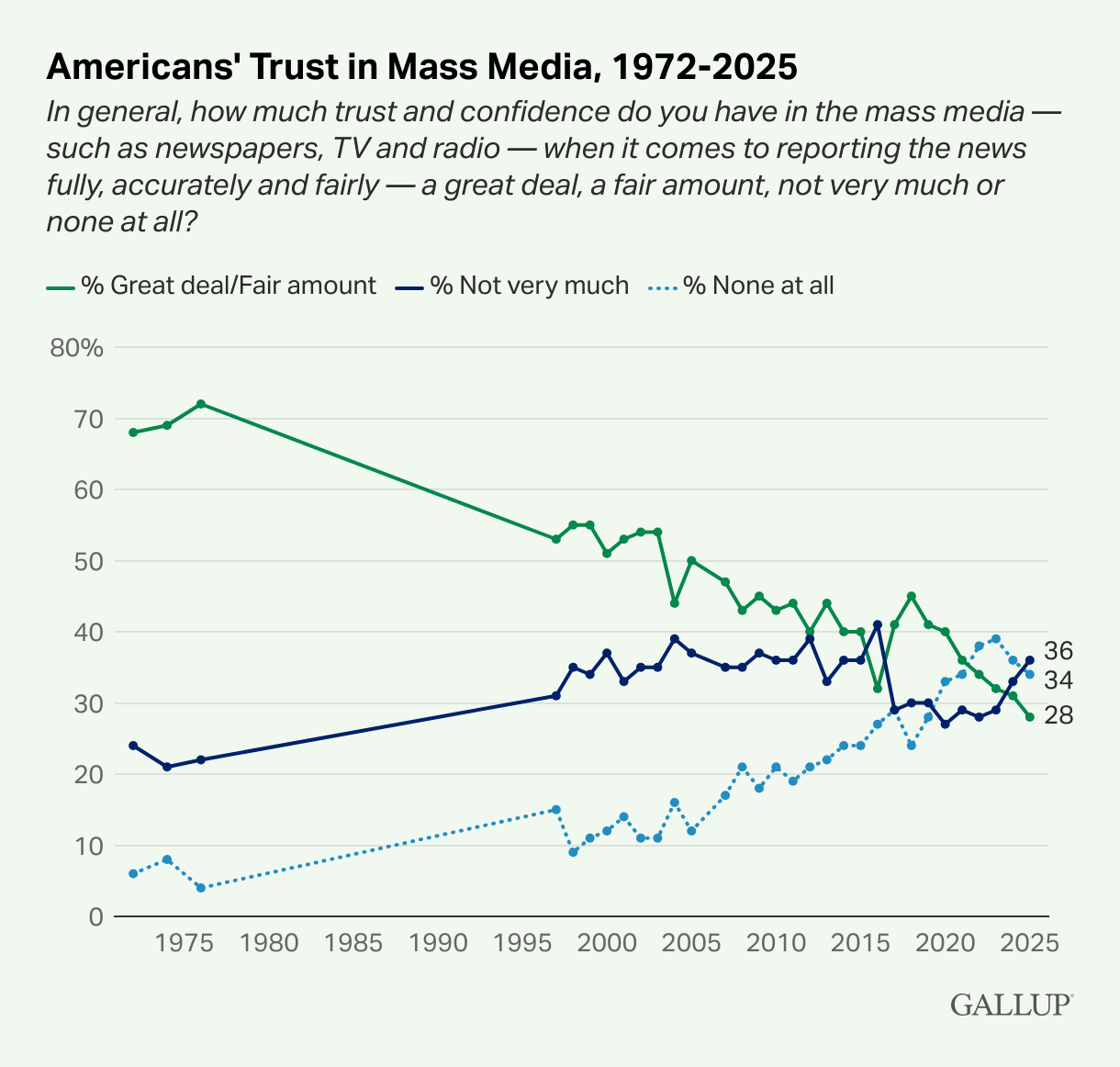
We are in the middle of a historic trust recession across most major institutions in American life. We believe this loss of trust is partially the result of macro trends, such as the social impact of rapid advancements in communications technology. Many Americans receive information about their communities and leaders from influencers and partisan actors, who are incentivized by algorithmic logic of their platforms to stoke rumors, confusion, and misinformation. However, we also believe the decline of trust in centralized media authorities is the result of some cultural blind spots and outdated practices. Gigafact seeks to address these factors with specific organizational philosophies and policies designed to earn back public trust in journalism.
Reasserting local expertise
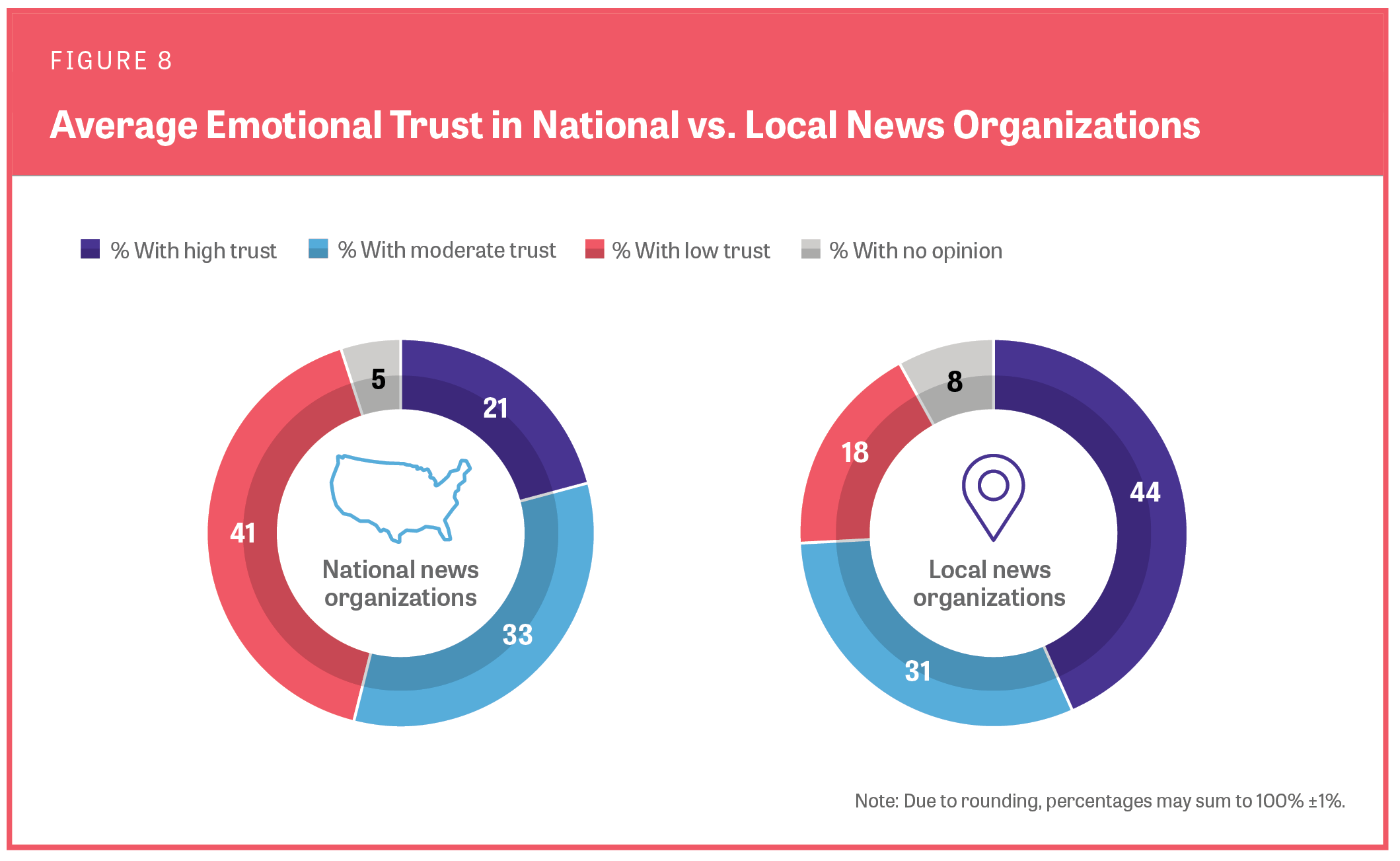
American politics has become increasingly nationalized in recent decades. Simultaneously, local journalism business models collapsed, creating news deserts where people can only receive national news. Despite these headwinds, local newsrooms are still among the most trusted remaining information sources, and Gigafact has purposefully sought out partner newsrooms who are rebuilding local journalism in their states and cities. Most of our partners are part of a movement of nonpartisan publishers that seek to provide valuable services to readers and subsist on their support. These newsrooms publicly pledge to maintain high levels of accuracy, transparency and nonpartisanship in their journalism. We believe these newsrooms represent green shoots in a parched local news landscape and have great potential to reinvigorate trust in journalism.
Nonpartisanship and non-advocacy
Facts about the world, our country, and our neighborhood are supposed to offer a reliable bedrock of shared reality for all of us. In recent decades, however, the concept of facts itself has been politicized. Individuals may dismiss factual findings because they tend to distrust knowledge-producing institutions, which they view as putting a thumb on the scale for left-leaning conclusions. We believe this distrust, while overblown, is not entirely unearned, given that some journalists and their organizations have stepped away from principles of objectivity and taken activist stances in recent decades.
We do not think that facts should be divorced from politics. Facts shouldn’t limit policy and ideology differences. Rather, these facts should offer a foundation of shared reality from which to advocate for competing ideas about how our world should evolve. We are pleased, therefore, when we see left- and right-leaning political actors lean on Fact Briefs to make their cases.
Our hope is that facts, when developed transparently and delivered without agenda, can become trusted again on all sides of our politics.
Meeting readers where they are
We believe that meeting readers where they are leads to greater trust in journalism and facts. What does this mean in practice?
- Responsiveness, rather than agenda-setting: This means publishing on topics and questions that are already on the public’s mind, rather than solely reporting on what we think audiences should know.
- Conforming to modern media consumption habits: On average, most readers will no longer read 3,000-word articles. In order to reach audiences, newsrooms must compete in different media formats and/or size their reporting so that readers can get the picture in a few words.
Notice that none of these principles precludes the deployment of rigorous journalistic practices. We believe that exceptional sourcing for a 150-word Fact Brief on something as small-seeming as “Did tumbleweeds first appear in the US in South Dakota?” contributes to this trust-building because it responds to a real discussion taking place and gets the point across swiftly and efficiently. At Gigafact, all good-faith claims and questions are taken seriously.
Policies for safeguarding trust
Publisher criteria
Gigafact’s publisher criteria are one way we put our trust philosophy into practice. We work with publishers that are committed to fact-first, non-advocacy journalism and willing to follow the evidence wherever it leads, even when the facts are inconvenient to a particular ideology or audience.
We prioritize well-regarded local and regional newsrooms, along with select academic and research organizations, because they are often best positioned to explain important issues clearly and credibly to the communities they serve. We also look for publishers whose mission is public understanding, not activism, and whose work focuses on addressing rumors, confusion, and unsupported claims with concise, transparent reporting.
As an example of this policy in action, Oklahoma Watch, a Gigafact news partner, published this newsletter validating various surprising statements by a conservative politician as accurate and factual. This type of reporting, where newsrooms not only debunk, but also corroborate claims from diverse political perspectives, is in the true spirit of Gigafact.
Audits of newsrooms
Our vetting process is designed to support that reader-trust posture. Before admitting a publisher, we review its journalism, mission, funding, affiliations, opinion content, social presence, and third-party bias or factuality indicators to assess whether it can genuinely advance a nonpartisan, service-oriented model of journalism. Taken together, these criteria help ensure that Gigafact’s Fact Briefs are produced by partners whose credibility comes from consistency, transparency, and a demonstrated commitment to informing the public rather than persuading it.
Future publisher criteria
In Gigafact’s early years, as we’ve worked to prove out our model and build trust with readers, we have tightly circumscribed who can participate in publishing Fact Briefs (as described above). However, we recognize that in order to scale and adapt to changes in the media landscape, Fact Brief publishers must expand to include nontraditional news purveyors, opinionated outlets, influencers, etc. We will be experimenting in future months to see if our training and compliance systems for ensuring Fact Brief quality are robust enough to accommodate these voices as well.
Fact brief guidelines
A keystone of Gigafact’s approach to trust is the Fact Brief guidelines. This document is the foundation of Gigafact’s training on Fact Brief writing, and each guideline is designed to earn the trust of a skeptical reader. These are the essentials for every Fact Brief and how they work together to make sure Fact Briefs are as trustworthy as possible.
Claim responsiveness
Because every Fact Brief is based on a claim made by a real person, it is crucial to represent people’s assertions both accurately and fairly. Their core argument should be faithfully reproduced in question form without any politically motivated slant.
Definitive answers
Fact Briefs’ “yes” or “no” answers limit topics to those definitively answerable and avoid the ambiguity that may tempt nonfactual interpretations, judgments, inferences, extrapolations, and other forms of inappropriate discretion.
Factual accuracy
Writers and editors must always cross-check each fact with its corresponding high-quality source before publishing to ensure all cited information is correct.
Unbiased communication
Fact Briefs seek to inform rather than inflame conversations by conveying the key factual information while avoiding taking sides or making value judgments. Neutrality is practiced at all stages of the process, from selecting claims to phrasing headline questions to writing the briefs themselves.
Transparent, high-quality sourcing
Each fact asserted in a Fact Brief must be supported by a reputable, publicly accessible, and nonpartisan source, with heavy reliance on primary sources whose methodologies are transparent.
Corrections, retractions, and updates
Gigafact encourages its publishers to maintain a rigorous corrections, retractions, and updates policy. To read more about these requirements, see our Guidelines, Principles & Methodologies.
Gigafact donors and their relationship to us
Gigafact is a nonprofit, and we rely on donations from individuals and philanthropies to support our work. Our supporters come from a variety of backgrounds and have a diverse range of priorities. These priorities and ideological commitments have no bearing on Gigafact, Fact Briefs, or their findings.
We aim to be transparent regarding our funding. Our donors list includes donors who have contributed $5,000 or more to our organization.
From time to time, a supporter may make a gift to Gigafact that is earmarked for the expansion of the Fact Brief program to a new state or locality. When this happens, the newsrooms in question must still meet our Publisher Criteria and pass our audit.
Gigafact Code of Principles
We try to practice what we preach! Achieving our mission in these polarized times requires Gigafact to have the people who are associated with our work conduct themselves in a manner that builds trust in Gigafact.
Gigafact’s mission relies on foundational systems that enable a vibrant democracy such as a free and open election system, a free and open press, and a healthy information ecosystem that advantages facts. We seek out people who align strongly with protecting these systems, and ask all employees and board members to abide by the Gigafact Code of Principles.
In brief, this code requires the following of individuals associated closely with Gigafact:
- A personal commitment to objectivity, rationality, and nonpartisanship, and an attitude of truth-seeking through the accumulation and assessment of evidence, and bringing this spirit to all work relating to Gigafact.
- A commitment to avoid publicly campaigning or fundraising on behalf of politicians, ballot measures, or socially sensitive issues.
- Disclosing any history of running for office, campaigning on behalf of politicians or ballot measures, or general political activism.
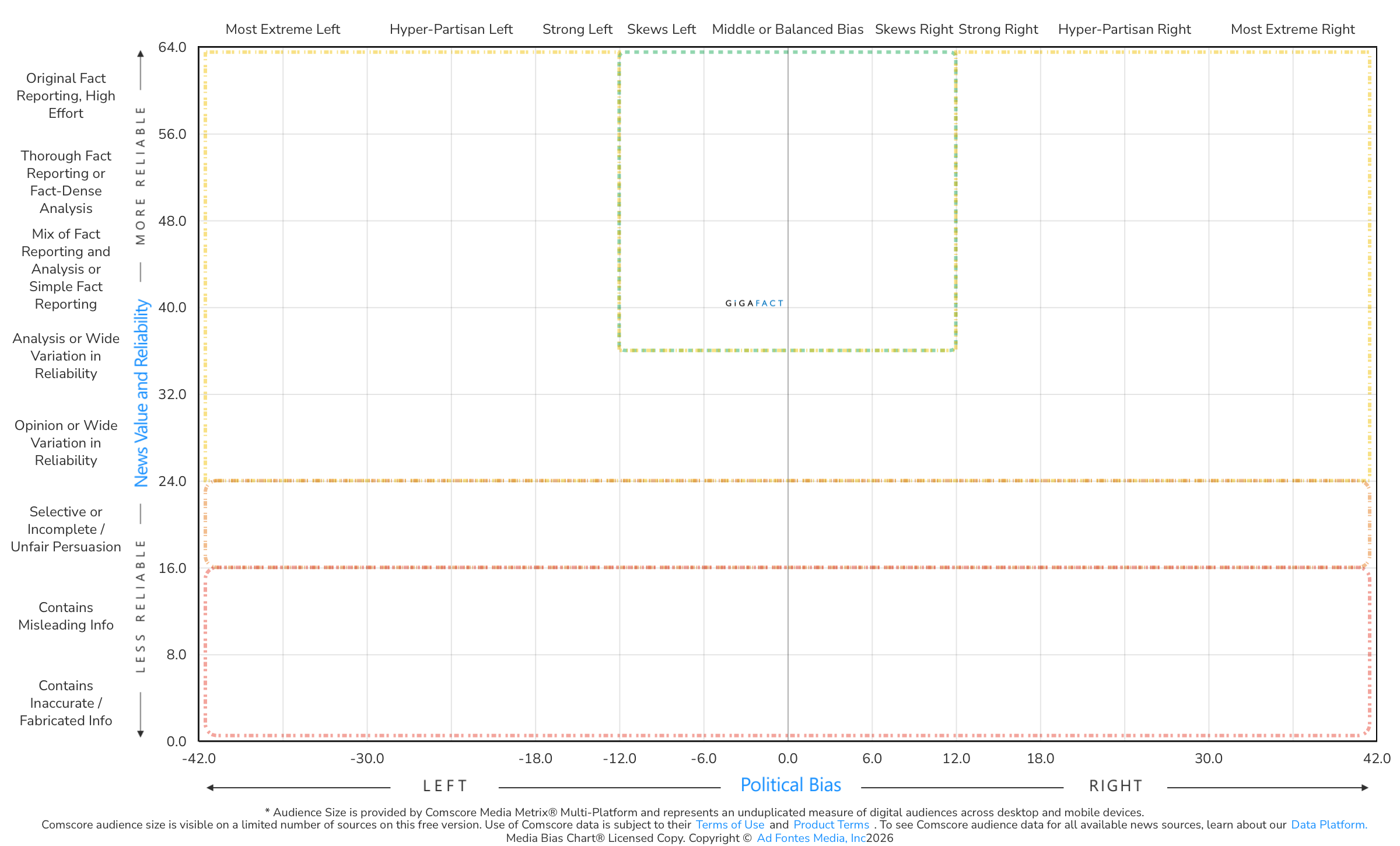
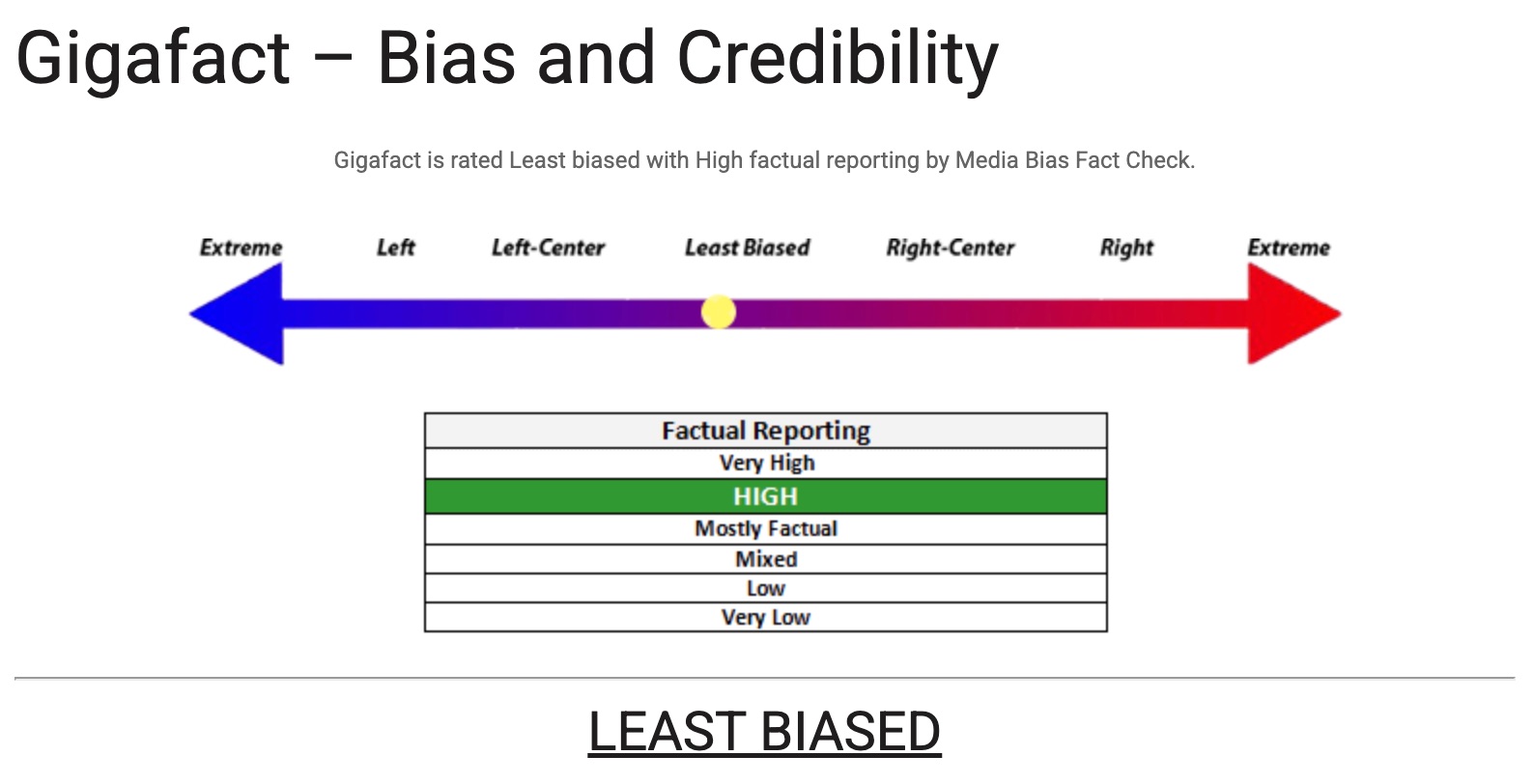
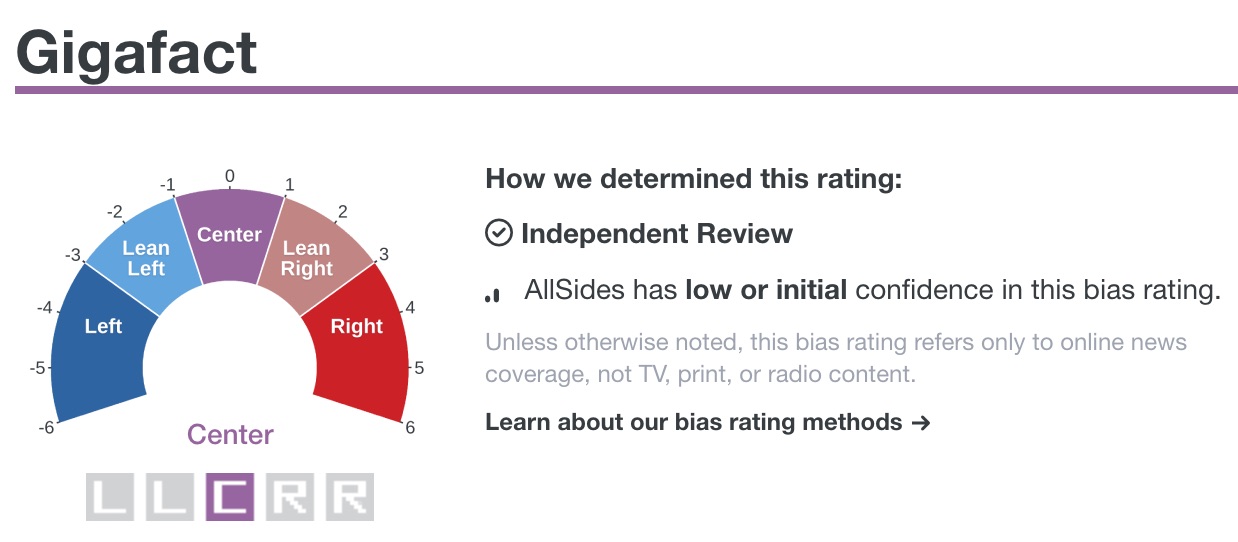
External assessments of Gigafact
Don’t just take our word for it! To offer further transparency to our nonpartisan mission, Gigafact subjects the entire body of Fact Briefs to ratings by third-party bias rating services such as Ad Fontes, AllSides, and Media Bias Fact Check. Gigafact (represented by the Fact Briefs published by its newsroom partners) is rated as “center” or “least biased” (as unbiased as you can get).